
Romans
Day 64

SCRIPTURE
14I myself feel confident about you, my brothers and sisters, that you yourselves are full of goodness, filled with all knowledge, and able to instruct one another. 15Nevertheless on some points I have written to you rather boldly by way of reminder, because of the grace given me by God16to be a minister of Christ Jesus to the Gentiles in the priestly service of the gospel of God, so that the offering of the Gentiles may be acceptable, sanctified by the Holy Spirit.
17In Christ Jesus, then, I have reason to boast of my work for God. 18For I will not venture to speak of anything except what Christ has accomplished through me to win obedience from the Gentiles, by word and deed, 19by the power of signs and wonders, by the power of the Spirit of God, so that from Jerusalem and as far around as Illyricum I have fully proclaimed the good news of Christ. 20Thus I make it my ambition to proclaim the good news, not where Christ has already been named, so that I do not build on someone else’s foundation, 21but as it is written,
“Those who have never been told of him shall see,
and those who have never heard of him shall understand.”
22This is the reason that I have so often been hindered from coming to you. 23But now, with no further place for me in these regions, I desire, as I have for many years, to come to you 24when I go to Spain. For I do hope to see you on my journey and to be sent on by you, once I have enjoyed your company for a little while. (Romans 15:14-24, NRSV)
WHAT
Soon after my youngest daughter Lauren graduated from college, she went to work for Campus Crusade for Christ, now called simply Cru. She was assigned to work in a ministry called Bridges International, and specifically with two campuses in Houston that had a large number of foreign students – The University of Houston and Rice University. Some of my fondest memories are when we invited those mostly graduate level foreign students to our home for holiday meals (the dorms were shut down at those times and they needed somewhere to go). Many great conversations were held over those meals and during those visits. I got to meet students from places like Iraq, Romania, South Korea, Japan, England, Malaysia, Canada, and, of course, China. It was my great privilege to baptize a student from China as a result of Lauren’s ministry.
One particularly memorable conversation took place with post-graduate level Chinese physics students about the then recent discovery of the Higgs boson. One student was very curious how I, as a Christian pastor, knew anything about the Higgs boson! From his point of view as a Chinese atheist, pastors only knew about “fairy tale” stuff. He was shocked to discover the breadth of knowledge a Christian could have (especially one who used to be an engineer). That’s how bridges get built!
What fascinated me most about Bridges International’s strategy, which was the bedrock of my daughter’s ministry, was their realization that many of these foreign students were the best and brightest their country had to offer. Many had been given scholarships by their countries with the expectation that they would return home after their education. Bridges International figured that the best way to share the gospel with these countries was to introduce it to these students they sent abroad to study, for they would very likely become influential people in their countries when they returned home. Influence those who will be the future “movers and shakers” and you can best influence the culture.
Paul took a similar approach in regard to his mission to Spain.
Paul tells the Romans here at the end of his letter of his travel plans. Having worked tenaciously for the gospel in the eastern half of the empire – including what he calls Illyricum, an area which encompassed today’s Albania, Kosovo, Montenegro, Serbia, Bosnia and Herzegovina, Croatia, and Slovenia. By the way, this is the only mention in the New Testament of Paul’s ministry in this area. Luke does not even hint at it in Acts. That serves as a reminder of how little we really know about Paul’s travels. Anyway, having worked so long in the eastern empire, his plan now was to bring the gospel to its western half, and particularly, Spain:
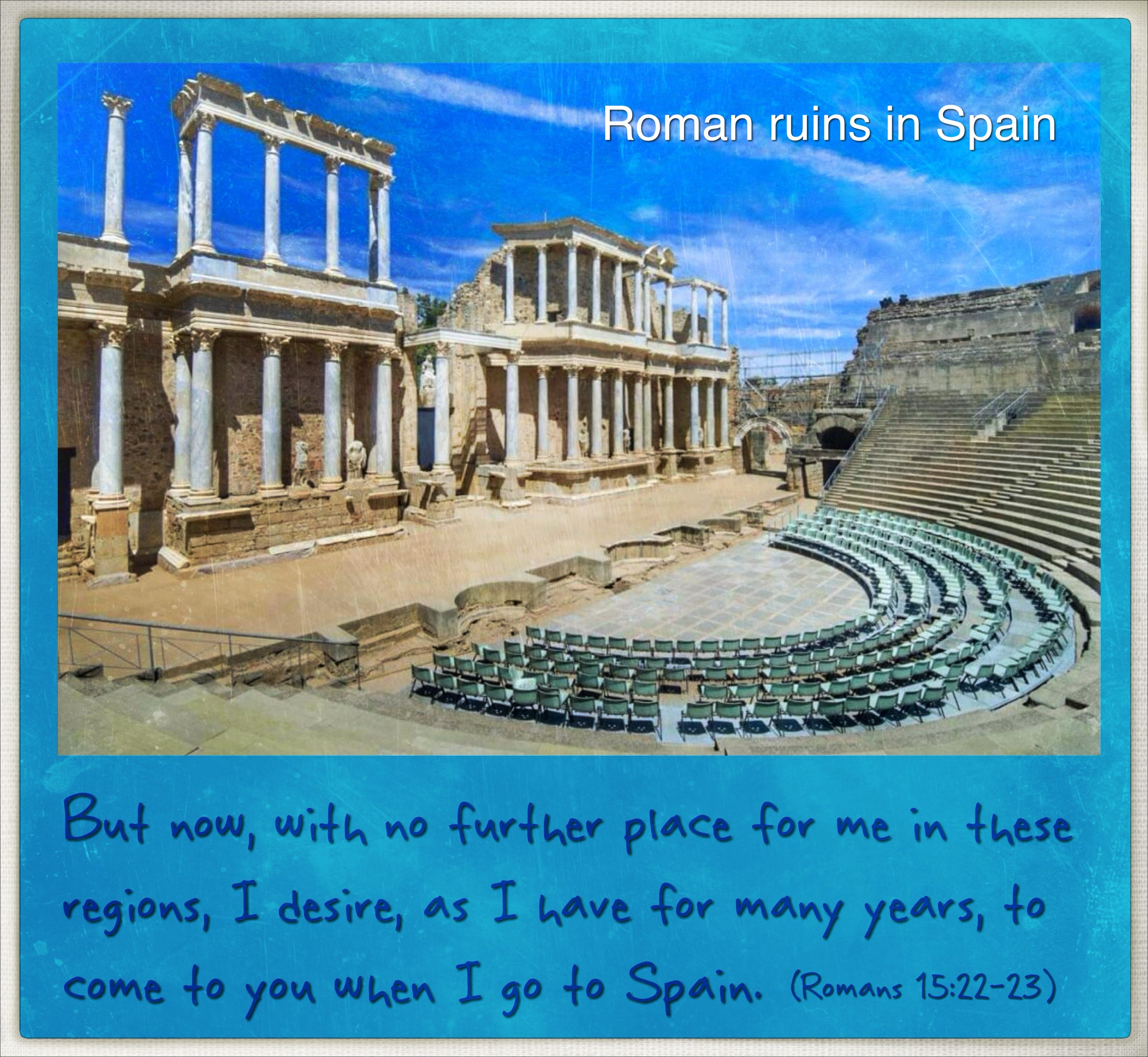
But now, with no further place for me in these regions, I desire, as I have for many years, to come to you when I go to Spain. For I do hope to see you on my journey and to be sent on by you, once I have enjoyed your company for a little while. (Romans 15:23-24, NRSV)
Why Spain? As N. T. Wright observes;
“Going to Spain is a whole new idea at this point in the letter. Nothing elsewhere in Paul, or indeed in Acts, prepares us for this ambition. But it is consistent with everything we know of Paul. For him, Spain would represent the western limits of the world and Paul, as we know, had a passion for bringing the gospel to the entire world (as he knew it).”
William Barclay notes something similar:
“It was in one sense the limit of the civilized world at that time, and that very fact would lure Paul on to preach there. He would characteristically wish to take the good news of God so far that he could not take it any further.”
Beyond that, there is evidence for first-century Jewish communities in Spain as there was virtually everywhere else in the empire. So Paul was longing to do there what he had done everywhere else.
But even more, Spain had been a major center of Roman influence for centuries by this time. Some of the best and brightest people the Roman empire had to offer came from Spain. It was experiencing a kind of blaze of genius, says Professor Barclay. Many of the greatest figures in the Empire of Paul’s time were Spaniards:
· Lucan, the epic poet
· Martial, the master of the epigram, which were pithy one liner zingers
· Quintilian, the greatest teacher of oratory of his day
· And above all, Seneca, the greatest and most well-known of the first century Stoic philosophers, who was at first the guardian and afterwards the prime minister of Nero
This is where I see the similarity of Paul’s strategy with that of Bridges International. It may well be that Paul realized that if he could bring Christ to Spain and there influence the next generation of influential leaders, tremendous things would follow.
When we recall that Paul had never been to Rome before, and most of the people in the Roman church did not know him – though they probably heard of him, but what they heard may not have been complimentary – we can detect Paul “the politician” dancing around the edges of some potential misunderstanding here:
For I do hope to see you on my journey and to be sent on by you, once I have enjoyed your company for a little while. (Romans 15:24, NRSV)
“To be sent on by you” means he hoped they would financially support his mission. Therefore, he must be careful not to offend them – and we know the Roman church was probably easily offended due to its internal tension between Jewish and Gentile disciples. So he says, “once I have enjoyed your company for a little while,” then I’ll go on to Spain. When he says, “enjoy your company,” it reminds us of the dance he did back in chapter 1:
For I am longing to see you so that I may share with you some spiritual gift to strengthen you -- or rather so that we may be mutually encouraged by each other’s faith, both yours and mine. (Romans 1:11-12 (NRSV)
We saw earlier that Paul is essentially saying:
For I am longing to see you so that I may share with you some spiritual gift of mine to strengthen you – er, I mean, rather that we may be mutually encouraged by each other’s faith, both yours and mine.
Dance, Paul. Dance. But that is essentially what he says again here at the end of the letter, but more carefully this time. “Once I have enjoyed your company for a little while…” rather than “Once you have enjoyed my company for a little while…”
As Paul said at the beginning of the letter, so he says again here at the end: “I have intended to come to you for a long time – you are that important to me. But I have been so busy I have been prevented -- until now.”
I want you to know, brothers and sisters, that I have often intended to come to you (but thus far have been prevented), in order that I may reap some harvest among you as I have among the rest of the Gentiles. (Romans 1:13, NRSV)
This is the reason [i.e., all the places in which he has ministered which he just listed] that I have so often been hindered from coming to you. (Romans 15:22, NRSV)
Having told the Romans he plans to come visit them, and hopefully gain their financial support for his western mission -- perhaps even establishing Rome as his new home base (as Antioch was in the east) – in the next section he tells them he must do something first. He must first go to Jerusalem from Corinth, where he was when he wrote this letter, to deliver a financial collection for the relief of the saints there. This is the collection that he has taken up among the Gentile churches he established in Macedonia and Achaia, work which we can clearly see in the Corinthian letters. Paul views this not just as a mission to relieve the Jewish disciples’ suffering in a famine, but as a “put your money where your mouth is” sign of what was Paul’s bedrock ministry principle – the ONENESS of the family of God in Christ, especially the ONENESS of Jew and Gentile.
Coming to Rome on his way to Spain was a high priority mission for Paul. But delivering this tangible sign of ONENESS to Jerusalem was even higher. The joining together of Gentile and Jew in the covenant people was not just a sweet thing to see. It was not just a tip of the hat to unity in the Church. It was what Paul called in Ephesians “the mystery of his will” (Ephesians 1:9) which was “made known to me by revelation” (Ephesians 3:3). As we know from Acts, his plans got significantly derailed when he got to Jerusalem. Back to that in a moment.
So those were Paul’s plans as he states them at the end of today’s passage. What about the opening part of this passage?
I myself feel confident about you, my brothers and sisters, that you yourselves are full of goodness, filled with all knowledge, and able to instruct one another. Nevertheless on some points I have written to you rather boldly by way of reminder, because of the grace given me by God to be a minister of Christ Jesus to the Gentiles in the priestly service of the gospel of God, so that the offering of the Gentiles may be acceptable, sanctified by the Holy Spirit. (Romans 15:14-16, NRSV)
We learn here some more about how Paul viewed his ministry among the Gentiles. He saw himself as a priest at the temple. Instead of offering up animal and grain sacrifices to God, he was offering the Gentiles with their newfound faith and obedience to God, an offering he hoped would be acceptable to God and sanctified by the Holy Spirit. As Bishop Wright points out, this was a bold move because, “No pagan had ever imagined such a thing happening. No Jew had ever thought of it like that, let alone attempted it. That was what it was like being a pioneer.” Paul had been, was still, and planned to continue to be a bold pioneer breaking new ground. In the words of Captain James T. Kirk of the Starship Enterprise, Paul’s M.O. was “To boldly go where no man had gone before.” (A Star Trek reference if you don’t recognize it.)
But bold as he was, Paul was very conscious that there were other apostles. There were other missionaries who had also gone around the empire announcing the good news of Jesus. We know of other Jewish missionaries who taught that Gentiles could become disciples of Jesus, but they had to submit to the law of Moses first. Some of them had visited churches which Paul himself had founded, and they had often really stirred things up, causing quite a few problems for Paul. We can see this in the two letters to Corinth, especially in 2 Corinthians 11 where he sarcastically refers to “super apostles”. The entire letter to the Galatians was written to clean up a mess left by these other Christian missionaries.
Given his negative past encounters with other Christian missionaries, who held different visions of the gospel, Paul was naturally anxious in case he should do to other pioneers what others had done to him. This was particularly so as he planned his visit to Rome.
In this passage we can see Paul gingerly dancing around the issue of being bold but not wanting to trample on other missionaries:
In Christ Jesus, then, I have reason to boast of my work for God. For I will not venture to speak of anything except what Christ has accomplished through me to win obedience from the Gentiles, by word and deed, by the power of signs and wonders, by the power of the Spirit of God, so that from Jerusalem and as far around as Illyricum I have fully proclaimed the good news of Christ. Thus I make it my ambition to proclaim the good news, not where Christ has already been named, so that I do not build on someone else’s foundation, but as it is written,
“Those who have never been told of him shall see, and those who have never heard of him shall understand.”
This is the reason that I have so often been hindered from coming to you. (Romans 15:17-22, NRSV)
Bishop Wright points out how difficult it is to accurately translate Paul’s language in vv. 18 and 20. He is dancing so much around this issue of not wanting to denigrate the work of other missionaries. If you look in your Bible, you might see a footnote around v. 18, as I do in the NRSV. That footnote says, “GREEK: ‘speak of those things that Christ has not accomplished.’” So in this case, the Greek text reads, “For I will not venture to speak of those things that Christ has not accomplished through me to win obedience from the Gentiles…” In other words, “I acknowledge there has been good work done by others to win obedience from the Gentiles. I speak only of what I have done.” Or he could mean, “For I will not dare to say anything of what the Messiah has not accomplished through me for the obedience of the nations in word and deed.” In this case, he would be acknowledging that in a city of roughly one million people and a church of maybe 100-200 people, there’s still plenty of fresh work to be done without having to step on anyone’s toes.
Why would Paul dance so much when writing to the Roman church? Because he was not the founder. Someone else did that missionary work before he even got there. Who was the founder of the church in Rome? Short answer: We don’t know.
Tradition says Peter was the founder of the church in Rome. The problem with that, however, is that there is no firm evidence for it. Some people think the gospel arrived in Rome simply due to the many ordinary Christian witnesses who would have reason to travel to the seat of the empire, people whose names are now unknown to us. Lack of clear evidence aside, maybe Paul’s dancing is due to his being aware of the work of Peter in Rome. We’re about to see in the next chapter that Paul knew several people in the church that he had met through his own work. These people now lived in Rome. Maybe people like that founded the church. And there being so many certainly meant that Paul would have had quite a few supporters in Rome. But never-the-less, the consummate theologian and missionary was also a skilled politician, by which I simply mean he knew people were people and their feelings and beliefs had to be taken into account. Perhaps this accounts for the dancing around we see in this passage.
So Paul plans to come to Rome. He has no desire to build on the foundation someone else has laid (Bishop Wright notes that he uses the same image in 1 Corinthians 3:10-17, where it’s clear he sees his own vocation as a primary founder, not a secondary builder), but to do fresh work for the gospel. That is his identity, church planter. It has always been his primary task. As is so common for Paul, as we see throughout this letter, he understands his task in the light of scripture. In this case, he refers in verse 21 to Isaiah 52:15. That verse speaks of the Suffering Servant and of those who announce his work to the world.
I want to end with an obvious question. Paul is passionate about extending his missionary work to the west, to Spain in particular, for reasons we have looked at. He is very interested in visiting Rome to further that work. He even told the Romans:
I know that when I come to you, I will come in the fullness of the blessing of Christ. (Romans 15:29, NRSV)
But Paul was equally passionate, if not more so, about delivering the Gentile offering to the Christians in Jerusalem. We modern readers know something Paul didn’t know when he wrote this letter. We know that he will make it to Rome, alright. But as a prisoner in chains. We know he will spend considerable time under house arrest in Rome, not free to move about to do the gospel work he planned. And so far as we know (one minority tradition we discussed in the Background Commentary aside), we believe that Paul never made it to Spain. God did not answer his prayer about going to Spain. Or the answer was “not according to your plan.” What are we to make of this? What then of “the fullness of the blessing of Christ” Paul expected?
Bishop Wright asked this same question. His take on it, I find to be refreshing, and something we all need to keep in mind when our prayers get a “no” answer, or our best laid plans are thwarted. He says:
“Perhaps God sometimes allows us to dream dreams of what he wants us to do, not necessarily so that we can fulfil all of them – that might just make us proud and self-satisfied – but so that we will take the first steps towards fulfilling them. And perhaps those first steps (as they appear to us) are in fact the key things that God actually wants us to do. Paul may not have got to Spain. That didn’t matter; the gospel got there fairly soon anyway. What mattered then, and has mattered enormously in the whole history of the church, is that, as part of his plan to go to Spain, he wrote Romans. We should never underestimate what God will do through things which we see as small steps to a larger end.” (Emphasis mine)
Wow. I find that very helpful to explain some of my own experiences of disappointments in prayer.
In the next passage, Paul tells the Romans what he must do first before coming to them – the trip to Jerusalem. And he’ll appeal to the Romans to pray for the success of that trip. Was it successful?
APPLY
I should never underestimate what God will do through things which I see as a small step to a larger end.
PRAYER
God, thank you for N. T. Wright’s insights into what might look like a failure on Paul’s part, or worse, your failure to answer the prayers he asked for. I have experienced disappointments in my prayers also, particularly church appointments I did not get. This helps. In Christ. Amen.
QUESTIONS FOR DISCUSSION
1. Why did Paul plan to travel to Spain? How does his strategy parallel that which Bob described used by Bridges International, with which his daughter once served?
2. Where do we see Paul as a politician in these verses? Why is his Greek grammar so broken and he seems to be dancing around something? What is that something?
3. Before Paul could visit Rome, he had to do something first, which he outlines in the next passage. What was that? Why did it take priority over visiting Rome?
4. Paul is passionate about extending his missionary work to the west, to Spain in particular, for reasons we have looked at. He is very interested in visiting Rome to further that work. We modern readers know something Paul didn’t know when he wrote this letter. We know that he will make it to Rome, alright. But as a prisoner in chains. We know also that Paul most likely never made it to Spain. God did not answer his prayer. Explain N. T. Wright’s take on this. What does that take say to you amidst your own unanswered prayers and disappointments?
How can you apply these insights in your life?